







Gift Certificate
Join FREE Newsletter

My Account Logout Contact Us Subscribe Now! Login Contact Us
Home Product Tests  Warnings  Encyclopedia News Where to Buy
 
 
Product Review: Echinacea
 

Initial Posting: 3/18/04
POPULAR HERB HAS HIGH FAILURE RATE  
 

Seal of Approval Alphabetical list of brands for the 32 products tested.

Eclectic Institute Planetary Formulas TruNature
Good Neighbor Pharmacy Premium Nature's Way Vitamin World
Nature's Resource Puritan's Pride Whole Foods
Nutrilite Sundown    
Make sure the supplement you take passed our test and is right for you!  Isn't your health worth it?
     CLICK HERE TO LOGIN
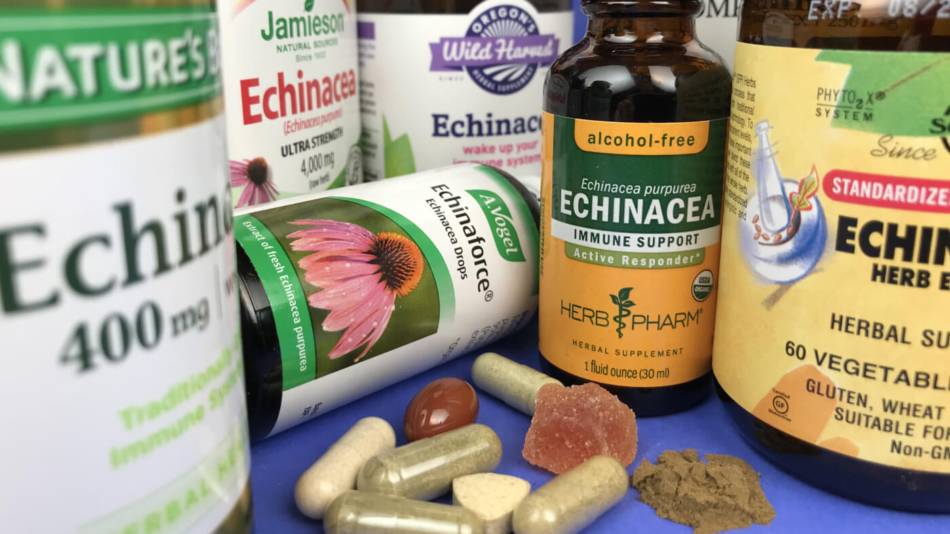
Eleven echinacea products were purchased and tested. Five failed. One had excessive lead contamination. Four had less key echinacea plant chemicals than claimed on their labels. Properly used, echinacea may help reduce the duration of colds.


You must subscribe to get the full test results and ConsumerLab recommendations. In this comprehensive report, you'll discover:
    • Which echinacea products failed or passed our tests and why.
    • How to pick and use echinacea supplements.
    • Potential concerns and cautions.

If you already are a subscriber, LOG-IN now.


Background:
Echinacea is a popular herb used primarily to reduce the symptoms and duration of colds and flu-like illnesses. It is believed to work through short-term stimulation of the immune system. The herb has not been proven to be effective for preventing disease and is not recommended for long-term use. In addition, it failed to help children with respiratory infections in one very large, well-designed trial. (See ConsumerTips™ for information about more dosing and usage).

There are three species of echinacea — E. purpurea, E. angustifolia, and E. pallida. Supplements are made from the above-ground herb (aerial) and/or root portions depending upon the species used. Like many other herbal remedies, it is not clearly understood which of echinacea's many chemical components are responsible for its effects. However, the various species of echinacea have been characterized as possessing certain marker compounds of the chemical class called "phenols." For example, cichoric and caftaric acids are phenols found within both the aerial and root portions of E. purpurea, while echinacoside is a phenol found in higher levels specifically within E. angustifolia and E. pallida roots. These phenols serve as markers to evaluate the quality of echinacea in a product. Other constituents that may be important include alkamides and polysaccharides.

Quality Concerns and What CL Tested for:
No government agency is responsible for routinely testing echinacea or other dietary supplements for their contents or quality. ConsumerLab.com has previously found that some echinacea products do not contain the proper ingredients or may be contaminated.

Microbial contamination can occur with herbal products, such as echinacea, during their growing, harvesting or production. The presence of microbes also can indicate decomposition of the plant material. As a result, the World Health Organization (WHO) has established standards for microbial contamination of medicinal plant materials intended for internal use. Furthermore the U.S. Food and Drug Administration (FDA) has established zero tolerance levels for certain disease-causing bacteria.

Echinacea can also be contaminated with lead or other heavy metals if grown in a contaminated environment.

ConsumerLab.com purchased and evaluated echinacea products to determine whether they contained the claimed and expected amount and type of echinacea (based on their chemical composition). They also were screened for microbial and lead contamination. All non-chewable tablets also were tested to be sure that they would properly disintegrate. Products had to meet FDA labeling requirements to pass this review. (See How Products Were Evaluated for information on testing methods and passing score.)

What CL Found:
Five of the products purchased by ConsumerLab.com, failed our tests. The reasons for these products failing are:
  • One had excessive lead contamination. The product contained over 2.5 micrograms of lead per daily serving. This exceeds the California state limit above which a warning label is required. While of itself not triggering a health problem for adults, it unnecessarily contributes to lead exposure. Higher than expected amounts of cichoric acid and lower than expected levels of echinacoside also were found. This suggests that the product was made with either the wrong plant species or the wrong part of the echinacea plant.
  • Four products were low in phenols — plant chemicals used to judge the quality of echinacea. It is believed by some that higher phenol levels relate to higher potency.
    • One product contained less than 5%, another 50% and the third 75% of its claimed amounts of phenols. The latter two did contain the minimum amount of phenols expected by CL but would mislead consumers into thinking that they provided higher amounts of phenols.
    • The fourth product claimed to contain 0.8% - 1.2% echinacoside and 3 - 4% total polyphenols. However, its label indicated that these levels were based on a method of analysis that is not an industry standard for echinacea. Using a more specific and accepted testing method, ConsumerLab.com found much lower levels — only 0.5% echinacoside and 0.7% polyphenols — concentrations that were lower than the minimums expected of good quality echinacea.
All products passed microbial testing and tests for cadmium and all caplet and tablet products were able to disintegrate properly.

Test Results by Product:
The table below shows some examples of products that passed. The names and results for all 11 products are available to subscribers.

EXAMPLES OF RESULTS OF CONSUMERLAB.COM TESTING OF ECHINACEA SUPPLEMENTS
Click on for additional information on the product
Click on beneath a product name to find a vendor that sells it.
To find retailers that sell some of the listed products click here.
Product Name (Labeled Ingredient, Amount,
Daily Dosage)
(Total Echinacea
Powder or
Extract
per day)**
(Click on "Ingredients" for Full Listing)

Company
(Dist. =
Distributor
Mfd. =
Manu-
facturer

Test Results:
(See Passing Score for More Information on Review Criteria)
APPROVED
(Passed)
or
NOT
APPROVED

(Failed)
Quality and Amount of Echi-
nacea
Purity (Conta-
minants:
(Lead, Cadmium,
Microbes)

Breaks Apart Pro-
perly (only for tablets)

Nature's Resource® Whole Herb Herbal supplement Echinacea (purpurea) 350 mg aerial parts (350 mg E. purpurea aerial powder/capsule, 4 capsules per day) (1400 mg powder daily)*
Ingredients
Dist. by Nature's Resource Products
APPROVED


NA

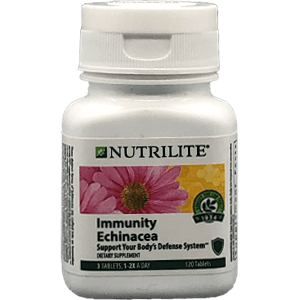
Nutrilite® Triple Guard Echinacea Dietary Supplement (168.7 mg E. purpurea root and aerial, E. angustifolia root extract/tablet, 3 tablets per day) (506 mg extract daily)*
Ingredients
Dist. by Access Business Group International LLC
APPROVED


Puritan's Pride Nature's Actives Herbal Extract Natural Whole Herb Echinacea Herbal supplement (400 mg E. purpurea aerial powder/capsule, 6 capsules per day) (2400 mg powder daily)*
Ingredients
Mfd. by Nutrition Warehouse
APPROVED


NA

Sundown® Echinacea, Natural Whole Herb (400 mg E. purpurea aerial powder/capsule, 4 capsules per day) (1600 mg powder daily)*
Ingredients
Dist. by Rexall Sundown, Inc
APPROVED


NA

Vitamin World® Select Herbal Echinacea
(400 mg E. purpurea aerial powder/capsule, 6 capsules per day)
(2400 mg of powder daily)*
Ingredients
Mfd. by Vitamin World, Inc
APPROVED


NA

*Tested through CL's Voluntary Certification Program prior to, at time of, or after initial posting of this Product Review.
** "Powder" refers to the dried echinacea while "Extract" refers to a concentrate (typically four times the concentration of the powder.)
Unless otherwise noted, information about the products listed above is based on the samples purchased by ConsumerLab.com (CL) for this Product Review. Manufacturers may change ingredients and label information at any time. So be sure to check labels carefully when evaluating the products you use or buy. If a product's ingredients differ from what is listed above, it may not necessarily be of the same quality as what was tested.

The information contained in this report is based on the compilation and review of information from product labeling and analytic testing. CL applies what it believes to be the most appropriate testing methods and standards. The information in this report does not reflect the opinion or recommendation of CL, its officers or employees. CL cannot assure the accuracy of information provided to it by third parties. Liability to any person for any loss or damage caused by errors, omissions, or inaccuracies in this report is hereby disclaimed.
Copyright ConsumerLab.com, LLC, 2004. All rights reserved. Not to be reproduced, excerpted, or cited in any fashion without the express written permission of ConsumerLab.com LLC.


Just click Subscribe or, if you already are a subscriber, Log-in now.


Want to see more?

To view this article in its entirety, please click below on the "Log In" button if you are already a subscriber or the "Subscribe" button to learn how to subscribe.


Subscribe | Log In
Home | Product Tests | Brands Tested | Natural Products Encyclopedia | Where to Buy Products | News | Recalls & Warnings
Athletic Banned Substance Tests | Raw Materials Tests | Testing Programs | The CL Seal | CL Book | CL Survey | About Us
Gift Memberships | Join Free Newsletter | Privacy Policy | Site Map | Contact Us/Help

©2009 ConsumerLab.com, LLC. All rights reserved. A single copy of a report may be printed for personal use by the subscriber.
It is otherwise unlawful to print, download, store or distribute content from this site without permission.
ConsumerLab.com name and flask logo are both registered trademarks of ConsumerLab.com, LLC.