




What CL Found:
As discussed below, while all of the walnut products met the requirements of Grade No. 1 walnuts by U.S. Department of Agriculture standards, they differed in terms of amounts of mold or yeast they contained and showed varying signs of oxidation (e.g., darker color, higher levels of hexanal, less buttery flavor). In addition, some were more accurately labeled than others regarding the amounts of walnut halves size of their walnut kernels (i.e., halves versus pieces). The cost to get an equivalent amount of walnuts ranged 5-fold, and higher price did not mean better quality.
Contamination — Mold
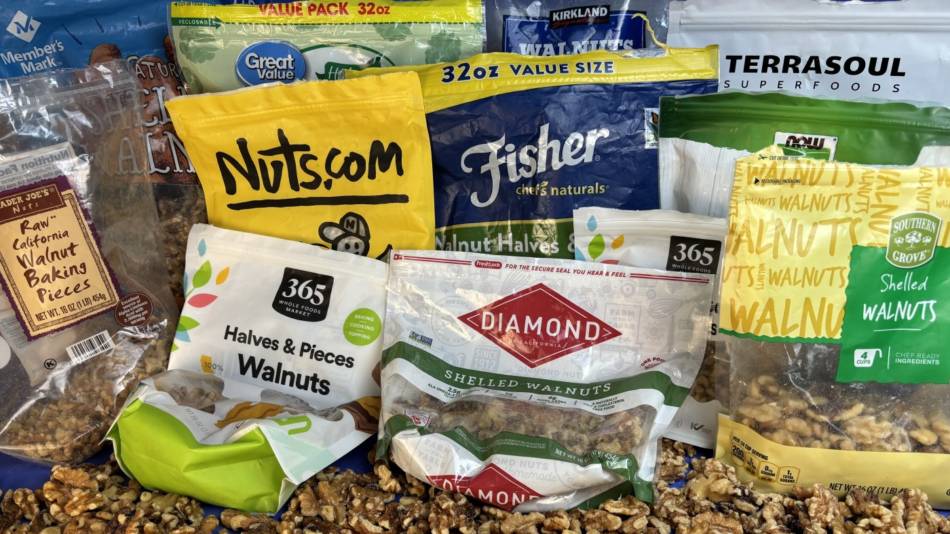
Although there was no visible mold on any of the walnuts (a test required by the USDA for grading walnuts), ConsumerLab was able to grow measurable amounts of mold (and/or yeast) from four products, as listed below. All samples were taken prior to "Best by" dates listed on packages and none of the bags were previously opened.
The first two products -- Diamond and Kirkland -- had amounts of mold exceeding a limit established by the USP for botanical products of 1,000 CFU/g (colony forming units per gram), although there does not appear to be an established limit for walnuts. While likely not dangerous, we believe this contamination should be considered by consumers even though the products still met the USDA requirements for Grade No. 1 shelled walnuts and none of the products in this Review contained measurable amounts of aflatoxins, which are toxic compounds produced by mold that can grow on walnuts.
-
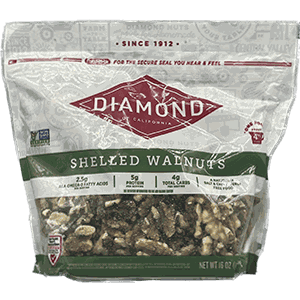
Diamond Of California Shelled Walnuts had the highest amount of yeast and mold — 2,700 CFU/g.
-
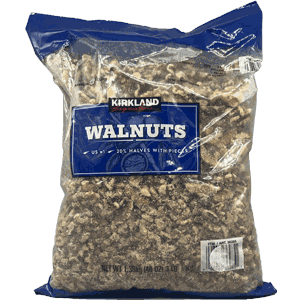
Kirkland Signature [Costco] Walnuts - 20% Halves With Pieces had the second highest amount of mold — 2,050 CFU/g. ConsumerLab also noticed that pieces appeared to have been smoothed — possibly to remove moldy or discolored portions of kernels.
-
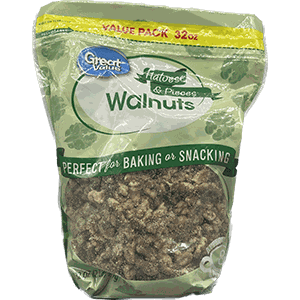
Great Value [Walmart] Halves & Pieces Walnuts had 600 CFU/g of yeast and mold. Although not particularly high, it was one of the few products with this contamination. Like Kirkland, pieces appeared to have been smoothed.
-
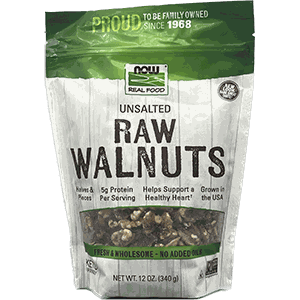
NOW Real Food Unsalted Raw Walnuts - Halves and Pieces had 250 CFU/g of yeast and mold, which is not high (although most other products had no detectable amount). As noted below, NOW had the highest amount of hexanal compared to the other products, suggesting more oxidation, and oxidation was further suggested by the particularly dark color of the kernels — 56% were amber or dark amber.
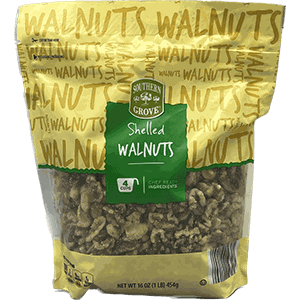
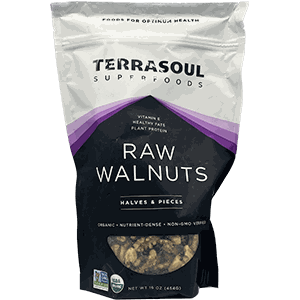
None of the products in this Review was found to be contaminated with other pathogenic microbes (E. coli, B. cereus, Salmonella, and Listeria), and none was found to exceed strict limits for contamination with heavy metals (lead, cadmium, arsenic, and mercury), although very small amounts of arsenic (0.16 to 0.53 mcg per serving) were found in three products: Nuts.com, Southern Grove, and Terrasoul. There is no established federal limit for arsenic in walnuts and the only state with a limit is California, where the limit is 10 mcg of inorganic arsenic per serving of a food, which is much higher than the amounts found. In short, the amounts of arsenic that we found do not pose a significant health risk.
Freshness: Hexanal, Color, and Flavor
All of the products tasted fairly fresh, but the best tasting had a somewhat buttery flavor and studies have shown that this is most common in products with lowest levels of hexanal — a compound that tends to increase as walnuts oxidize (i.e., start to become stale). Walnut color also tends to get darker (more amber or, even darker than amber) with oxidation.
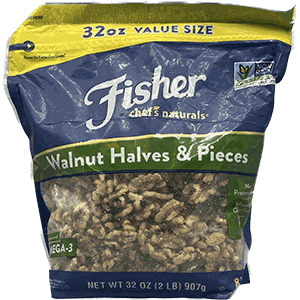
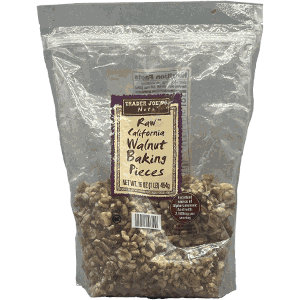
The graph below shows hexanal levels in the products — the lowest values are best. A value of "<0.3 mcg/g" means there was so little that it could not be quantified. Research suggests that the freshest walnuts have hexanal values below 2 mcg/g (Mexis, Food Control 2009), although truly rancid products tend to have values in the hundreds. Only two products had no quantifiable hexanal (<0.3 mcg/g): Fisher Chef's Natural Walnut Halves & Pieces and Trader Joe's Nuts Raw California Baking Pieces. Several products were below 2 mcg/g (Nuts.com, Southern Grove, Terrasoul, and Kirkland). The highest amount of hexanal, by far, was 35 mcg/g in NOW's halves and pieces. This probably explains its somewhat putty-like taste, as compared to a buttery taste in products like Nuts.com and Trader Joe's.
Color matters when it comes to walnuts because walnuts darken as they oxidize and become less fresh. Microbial infection can also darken walnuts. With that said, as long as the walnuts in a product are mostly light-color or shades of amber (see USDA color chart), the product should be fine. Only if more than 5% of walnut kernels in a lot are darker than amber does the USDA disqualify it from being Grade No. 1. It is likely that kernels that are darker than amber are intentionally removed when walnuts are processed.
As shown in the graph below, all of the products met the color requirement for Grade No. 1, as none had kernels considered darker than a shade of amber. However, some tended to be much darker than others. It is likely no coincidence that NOW, which had the highest level of hexanal (and some mold/fungus), was also the darkest of the products in kernel color, with 21% of kernels being dark amber and few being extra light (6%) or light (13%). It's probably best to look for walnuts that are light, rather than dark, in color.
Size of Pieces — Misleading Labels
If you want walnut kernels that are full walnut halves, we found that you need to choose very carefully and that labels can be misleading.
As shown in the graph below, many of the products labeled as "halves and pieces" were mostly pieces and should, more accurately, be called "pieces and halves." The situation was no better for products that were labeled simply as "shelled walnuts," as they mostly consisted of pieces and not halves.
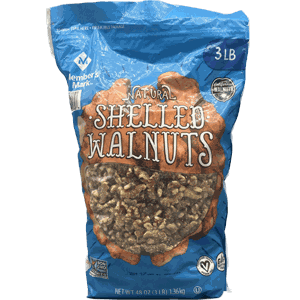
The only products that were mostly halves were NOW (66%), Fisher (59%), and Member's Mark (53%). Other than chopped walnuts, the products with the least halves were Great Value (Walmart) (22%), Diamond (24%), as well as Kirkland (Costco), although Kirkland's product name is fairly accurate -- "20% Halves with Pieces."
Some products appeared to have the edges of the walnut kernels smoothed (i.e., rubbed or rounded), which may have been done to remove discolored or moldy parts of kernels, and this was most common among products in which samples were found to grow mold or yeast. The walnut kernels in Nuts.com also seemed to be rounded and to have less pellicle (the thin, darker skin over the walnut meat) over large areas. It is possible that this was intentionally done to reduce the astringent taste from the pellicle, as Nuts.com had a particularly buttery and non-astringent taste.
A few products had noticeable amounts of walnut "dust" in the containers (noted in the 3rd column of the Results table), which gave them a less clean feel.
Cost
As shown below, the cost to obtain 30 grams (a little more than 1 ounce or ¼ cup) of walnuts from the products ranged 5-fold from just 18 cents (Member's Mark) to 99 cents (Terrasoul). Higher-cost products were not necessarily better in quality.