

Quick Summary
-
What is psyllium?
Psyllium supplements are made from psyllium seed husk, the mucilaginous coat that surrounds the psyllium seed. The husk is about 90% fiber, most of which (about 80% of the fiber) is soluble fiber. This soluble fiber can attract and bind water (absorbing about 10 times its weight in water), forming a non-fermentable, viscous gel. The remaining 20% of the fiber in psyllium husk is insoluble fiber that can also add bulk to stool. (See What It Is.) -
What are the health benefits of psyllium?
In the gut, the gel created by psyllium's soluble fiber 1) occupies volume and slows digestion, leading to fullness and helping to regulate blood sugar levels, and 2) softens and adds bulk to stool, providing a laxative effect. The gel may also bind to and reduce the absorption of a variety of compounds, which may explain its cholesterol-lowering effect. It is unknown if taking psyllium is helpful in achieving long-term weight loss. Methylcellose, a synthetic fiber, also provides a laxative effect but lacks the other benefits of psyllium. (See What It Does.) -
What problems did ConsumerLab's tests show with psyllium products?
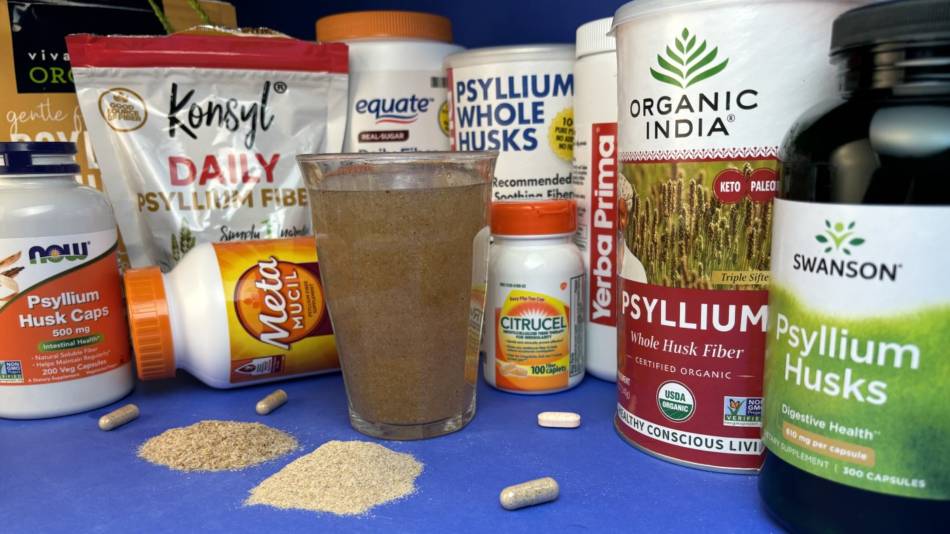
ConsumerLab.com's tests of the quality of psyllium products revealed that 4 out of 9 were contaminated with excessive amounts of lead — as much as 8.5 micrograms per 4 grams of fiber, yielding over 60X the California Prop 65 warning level in a maximum daily serving. Lead was found in all products, but those with the least contained only 1 mcg of lead or less per 4-gram serving of fiber. However, all products contained their expected amounts of soluble and insoluble fiber. (See What CL Found and How Products Were Evaluated.) 
What is the best psyllium?
ConsumerLab's overall Top Pick among Approved psyllium products (including those sold as supplements, foods, and OTC drugs) was selected for having the least lead contamination, the right amount of pure psyllium husk, and the correct amounts of soluble and insoluble fiber.-
What is the right dose of psyllium and how should psyllium be taken?
When starting with psyllium, start slow — with as little as ½ tablespoon of psyllium husk or ½ teaspoon of husk powder (which is denser, so a smaller serving is used). Dose can be increased to a full tablespoon or teaspoon per serving, taken one to three times daily, depending on the use.
Take psyllium with lots of water — at least 8 to 12 ounces with each serving, and more afterward. If mixing psyllium husk or powder in liquid, drink the liquid right after mixing -- before the liquid starts to gel. Timing around meals depends on whether you are using for laxation (stool softening), appetite control, or cholesterol-lowering. (See How to Use.) -
How safe is psyllium and what are its side effects?
Due to its fiber, psyllium can cause bloating, and some gas -- particularly when you start. Too much can cause diarrhea. Taking with too little water can cause constipation. Don't take capsules if you have difficulty swallowing. Medications should be taken at least one hour before or four hours after taking psyllium to help avoid interactions that can delay or reduce drug absorption. (See Concerns and Cautions.)