




Published
February 05, 2026
Quick Summary
What did CL's independent tests of DHEA dietary supplements find?
DHEA supplements tested by ConsumerLab.com were found to contain the amounts of DHEA claimed within a reasonable margin of error (see What CL Found and How Products Were Evaluated). However, one product did not appear to meet requirements of its special formulation.
Among DHEA supplements that were APPROVED for quality, ConsumerLab chose two as Top Picks based on quality and value.
Labeled amounts of DHEA in products tested varied considerably from 5 mg to 25 mg per pill — so it's important to choose one that provides the right dose for the intended use, at the best price. Taking multiple pills of a low-dose DHEA supplement to achieve a high daily dose could cost you as much as 12 times as much as you need to pay. The cost to get 25 mg of DHEA ranged from just 6 cents to 77 cents across supplements.
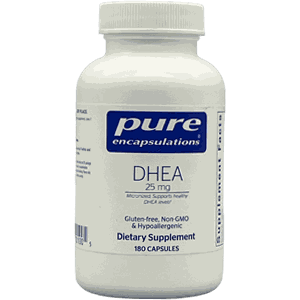
Products tested included DHEA pills by Designs for Health, Douglas Laboratories, Life Extension, Nutricost, Pure Encapsulations, and Vitacost.
What are the benefits of taking DHEA?
There is weak evidence that taking DHEA (dehydroepiandrosterone, a hormone the body uses to create other hormones, including estrogen and testosterone) may help improve mood, and in older men and women, sexual function as well as the appearance of the skin, although not general well-being, muscle mass, or mental function. Most studies have not shown a benefit of DHEA for athletic performance or as a weight-loss aid (see What It Does).
What is a DHEA supplement?
In the U.S., DHEA is sold as a dietary supplement—typically in capsules or tablets—rather than as an FDA-approved drug that requires a prescription.
How much DHEA should I take?
A typical dose is about 50 mg of DHEA per day, although for some uses, such as depression, the dose may be higher (See ConsumerTips™).
DHEA safety and side effects
DHEA may increase testosterone levels in women and should not be taken by women with hormone-sensitive diseases, such as breast cancer. It may also decrease HDL ("good cholesterol") levels and increase insulin resistance (see Concerns and Cautions for other potential side effects and drug interactions.)
Products tested in 2026
+— 38 sources
In addition the results of its expert testing, ConsumerLab uses only high-quality, evidence based, information sources. These sources include peer-reviewed studies and information from agencies such as the FDA and USDA, and the National Academy of Medicine. On evolving topics, studies from pre-print journals may be sourced. All of our content is reviewed by medical doctors and doctoral-level experts in pharmacology, toxicology, and chemistry. We continually update and medically review our information to keep our content trustworthy, accurate, and reliable. The following sources are referenced in this article:
- FDA, 11/17/2016
- Government of Canada, 2023
- Abbasifard, Int Immunopharmacol 2024
- Araneo, Ann N Y Acad Sci 1995
- Baulieu, Proc Natl Acad Sci USA 2000
- Brooke, J Clin Endocrinol Metab 2006
- Christiansen, Clin Endocrinol (Oxf
- Christiansen, Eur J Endocrinol 2011
- Danenberg, J Clin Endocrinol Metab 1997
- Gravisse, Int J Sports Med 2018
- Himmel, J Clin Rhematol 1999
- Igwebuike, J Clin Endocrinol Metab 2008
- Koothirezhi, StatPearls 2023
- Labrie, J Clin Endocrinol Metab 1997
- Mamas, Curr Opin Obstet Gynecol 2009
- Marder, Lupus 2010
- Mease, J Rheumatol 2005
- Nachshoni, Schizophr Res 2005
- Nagals, Cochrane Database Syst Rev 2015
- Petri, Arthritis Rheum 2002
- Rabkin, Am J Psychiatry 2006
- Ritsner, J Clin Psychiatry 2010
- Schmidt, Arch Gen Psychiatry 2005
- Van Vollenhoven, Ann Med Interne (Paris
- Wang, BJOG 2022
- Weiss, Am J Clin Nutr 2009
- Brniak, SPS 2015
- Arlt, Endocr Res 2000
- Casson, Am J Obstet Gynecol 1996
- Reiter, Urol Res 2001
- Aoki, Vitam Horm 2018
- Arnold, Endocrinology 2005
- Elraiyah, J Clin Endocrinol Metab 2014
- Gordon, Cancer Res 1990
- Helzlsourer, JAMA 1995
- Medical Letter Editor, Obstet Gynecol 2005
- Ng, J Am Coll Cardiol 2003
- Penisson-Besnier, Neurology 2008
As a ConsumerLab.com member, you may print a copy of this report for your personal use.
You can access a special print version by clicking the "Print" icon in the upper right corner of this report.
You can then use your web browser's print functions to print the whole report or just selected pages.
You may also email or post a link to this report using the web address above.
Non-members using the link will see a free summary and can join to view the full report.
Other means of copying or distributing this report, in part or full, are not permitted.
If you are sight-impaired and your computer is having trouble converting the text in this report to speech,
contact us for assistance at [email protected] or by
phone at 914-722-9149.
The "Latest Update" date indicates when new clinical or product information was most recently added. In the full review (available to CL members), the newest information is highlighted in yellow and, if a new product is added, it is footnoted in the results table, showing the date added to the review. The year(s) when testing was completed for the products in the review appears at the end of the Summary section.
|