Quick Summary
-
Why take a digestive enzyme supplement?
Digestive enzyme supplements can help you digest specific foods (such as beans and dairy, as well as carbohydrates, proteins, or fatty foods) when you do not naturally produce enough enzymes — such as among people with pancreatic disease. In such cases, taking enzymes can reduce bloating, gas, and diarrhea and increase the absorption of nutrients. (See "What They Are" for a list of enzymes and the foods they break down.) Enzymes may also have other beneficial effects, such as phytase to improve iron absorption from wheat and other plant-based foods. It is unclear if enzymes, such as bromelain and papain, help with pain and inflammation or reduce eye floaters. (See "What They Do" for information by medical condition.)
-
How to choose a digestive enzyme supplement:
Choose a digestive enzyme supplement that lists enzyme activity units (such as PU, HUT, FIP, etc.), not just the amount of enzyme (such as milligrams) since that won't tell you how potent the enzyme is (see "What They Do"). Also, check that ConsumerLab.com or another reputable independent 3rd party has verified the enzyme activity. As found in this Review, some products don't provide all the enzyme activity that they list and some provide much more than listed, putting them over tolerable limits (see "What CL Found" and How Products Were Evaluated).
Best digestive enzyme supplements?
See our Top Picks among Approved digestive enzyme supplements for overall best general product and specifically for digesting carbohydrates, fats, and proteins, and for providing bromelain and papain activity.-
When should you take a digestive enzyme?
If you're taking an enzyme to help with food digestion, enzymes generally work best when taken immediately before or during a meal. If you're taking an enzyme for pain and inflammation, take on an empty stomach, at least 30 minutes before a meal. (See How to take and Dosage.)
-
Are digestive enzyme supplements safe?
Digestive enzymes are generally well-tolerated, but people with allergies to a specific enzyme source, certain medical conditions, or who take medications such as blood-thinners or diabetes drugs may need to avoid specific enzymes. Rarely, nausea and allergic reactions have been reported with the use of lactase (see "Concerns and Cautions").
Products tested in 2022
+— 57 sources
In addition the results of its expert testing, ConsumerLab uses only high-quality, evidence based, information sources. These sources include peer-reviewed studies and information from agencies such as the FDA and USDA, and the National Academy of Medicine. On evolving topics, studies from pre-print journals may be sourced. All of our content is reviewed by medical doctors and doctoral-level experts in pharmacology, toxicology, and chemistry. We continually update and medically review our information to keep our content trustworthy, accurate, and reliable. The following sources are referenced in this article:
- Blonstein, Practitioner 1969
- Bolten, Arthritis 2014
- Brien, QJM 2006
- Büttner, B-ENT 2013
- Di Nardo, BMC Gastroenterol 2013
- Di Stefano, Dig Dis Sci 2007
- Fissore, Processes 2023
- Frank, Int J Sport Nutr Excer Metabol 2002
- Ganiats, J Fam Pract 1994
- Gao, Nagoya J Med 2002
- Glade, Nutrition 2001
- Hillila, Scand J Gastroenterol 2016
- Horng, J Am Sci 2019
- Kane, Ann Intern Med 2000
- Keller, Gut 2005
- Kim, Hypertens Res 2008
- Klein, Clin Exp Rheumatol 2006
- Kleveland, Scand J Gastroenterol 1990
- Lami, Am J Gastr 1988
- Lin, Dig Dis Sci 1993
- Ma, J Clin Med 2022
- Majeed, J Med Food 2018
- Messer, Lancet 1976
- Miller, J Sport Sci 2003
- Misran, Biocatal Agric Biotechnol 2019
- Misran, J Food Sci Technol 2022
- Money, Frontline Gastroenterol 2010
- Munasinghe, J Autism Dev Disord 2010
- Naeem, Pak J Pharm Sci 2020
- Oben, J Int Soc Sports Nutr 2008
- Pearson, JAMA Netw Open 2023
- Rowe, Acta Pharma Sci 2018
- Ryan, Headache 1967
- Saad, Clin Psychopharmacol Neurosci 2015
- Stone Clin J Sport Med 2002
- Suarez, Dig Dis Sci 1999
- Takeuchi, Appl Sci 2020
- Troesch, Food Nutr Bull 2013
- Vuppala, Sports Nutr Ther 2016
- Zatuchni, Obstet Gynecol 1967
- website
- Wei, Nutrients 2020
- Roxas, Alt Med Rev 2008
- definitions
- Anderson, Food Dig 2013
- Creon Prescribing Information 2015
- Cystic Fibrosis Foundation, 2021
- Diez-Gomez, Ann Allergy Asthma Immunol 1998
- EPA 1998
- Glyset Prescribing Information 2012
- Gutfreund, Hawaii Med J 1978
- Ishiguro, Clin Case Rep 2018
- Mansfield, Ann Allergy 1985
- Nettis, Allergy 2001
- Precose Prescribing Information 2011
- Russell, Dig Dis Sci 1980
- Shaw, Drug Saf 1997
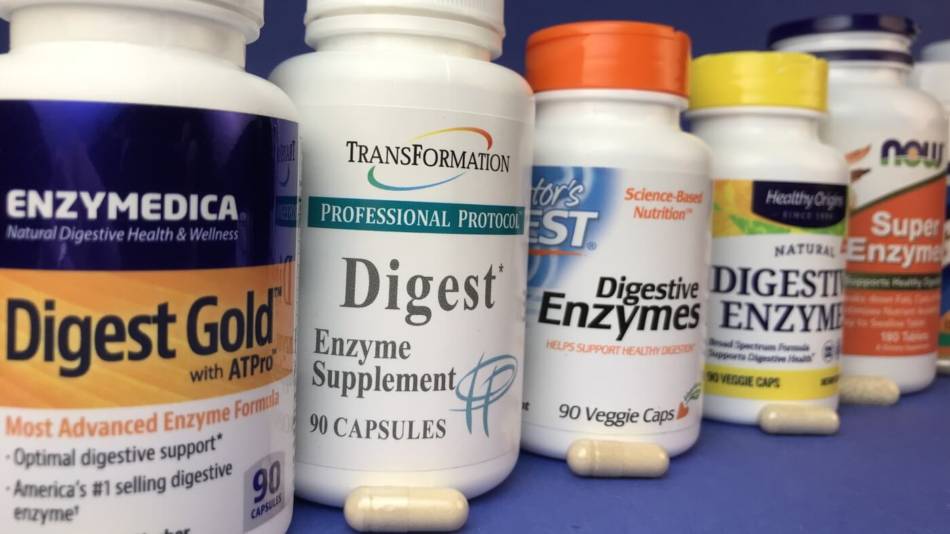
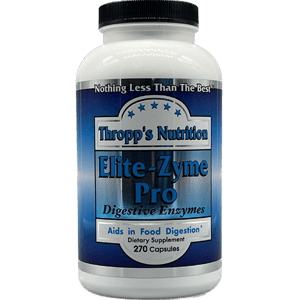
You must be a member to get the full test results for digestive enzyme supplements along with ConsumerLab's recommendations and quality ratings. You will get results for nine supplements, including eight selected by ConsumerLab.com and one other that passed the same testing through our voluntary Quality Certification Program. In this comprehensive review, you'll discover: 
- Which digestive enzyme supplements failed testing and which passed
- ConsumerLab's Top Picks among digestive enzyme supplements for digesting carbohydrates, fat, and protein, as well as our overall Top Pick
- What different digestive enzymes do
- The evidence for and against digestive enzymes for improving digestion and the absorption of nutrients, preventing indigestion and reducing symptoms such as gas, bloating, and diarrhea, helping with conditions such as lactose intolerance and ulcerative colitis, and other uses such as reducing pain and inflammation and treating eye floaters
- The amylase, lipase, and protease activity in each supplement
- Information about other key digestive enzymes found in supplements, such as lactase, alpha-galactosidase, cellulase, and phytase
- How to choose an enzyme supplement and the best way to take them, including what enzyme units to look for on labels and dosage for specific uses
- Potential side effects and drug interactions with digestive enzymes
As a ConsumerLab.com member, you may print a copy of this report for your personal use.
You can access a special print version by clicking the "Print" icon in the upper right corner of this report.
You can then use your web browser's print functions to print the whole report or just selected pages.
You may also email or post a link to this report using the web address above.
Non-members using the link will see a free summary and can join to view the full report.
Other means of copying or distributing this report, in part or full, are not permitted.
If you are sight-impaired and your computer is having trouble converting the text in this report to speech,
contact us for assistance at [email protected] or by
phone at 914-722-9149.
The "Latest Update" date indicates when new clinical or product information was most recently added. In the full review (available to CL members), the newest information is highlighted in yellow and, if a new product is added, it is footnoted in the results table, showing the date added to the review. The year(s) when testing was completed for the products in the review appears at the end of the Summary section.
|








.png)
.png)
.png)

.png)
.png)
.png)
.png)