ConsumerLab.com uses JavaScript to provide the best possible experience for our content, but your browser has it disabled. Learn how to enable it here.
There is mixed evidence as to whether glucosamine and chondroitin reduce symptoms of degenerative joint disease in dogs and cats. There is limited research suggesting that MSM may help with muscle soreness (see What It Does).
What did CL's tests of joint supplements for pets find?
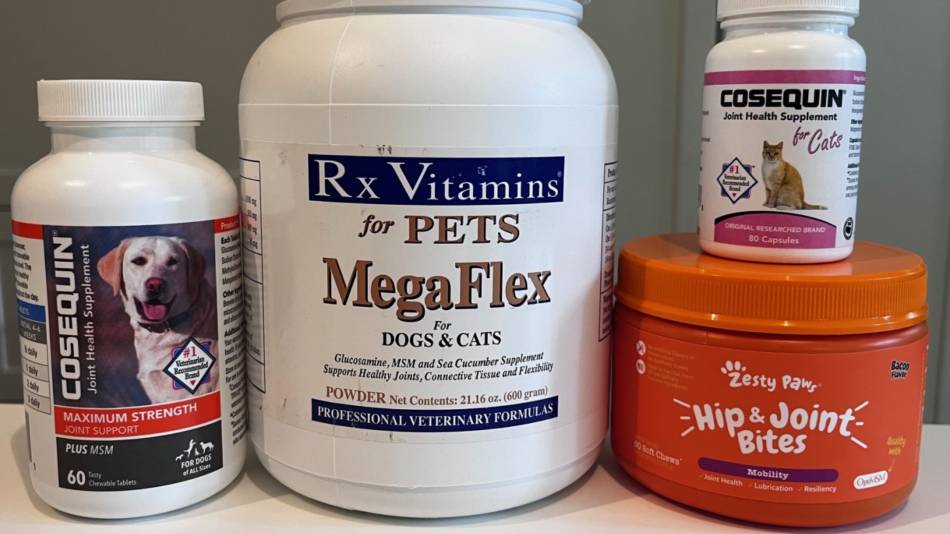
We tested products from Cosequin, RxVitamins, and ZestyPaws. One product was discovered to contain less than 10% of its listed chondroitin, and therefore, was Not Approved. (See What CL Found and How Products Were Evaluated.)
Which is the best joint supplement for pets?
Products that passed CL's tests for having the labeled amounts of ingredients and not exceeding our strict limits on heavy metal contamination are noted as Approved in the Results table, where they are also compared. Approved products that provided high quality ingredients at a reasonable price — indicating superior value — were our Top Pick for Dogs and Top Pick for Cats.
What dose of glucosamine, chondroitin, and MSM is usually given to pets?
Glucosamine and chondroitin: These may be used separately, but most supplements contain a combination. For a 25-lb. pet, a typical daily dose is 500 mg of glucosamine hydrochloride and 400 mg of chondroitin sulfate. Dosage for each of these ingredients should be adjusted depending on your pet's weight (see Dosage in ConsumerTips).
MSM: An optimal dose has not been established.
Side effects of joint supplements for pets
Most of these ingredients can cause some gastrointestinal upset, such as nausea and diarrhea, and, although generally safe, some can interact with drugs, trigger allergies, or cause other side effects. MSM may have an aspirin-like effect and shouldn't be used by pets already taking blood-thinning medications, unless medically supervised (see Concerns and Cautions).
What other types of joint supplements are given to pets?
You may also want to read ConsumerLab's Reviews of supplements for pets that contain fish oil, turmeric, and CBD, all of which have been promoted for treating joint pain and inflammation in pets.
In addition the results of its expert testing, ConsumerLab uses only high-quality, evidence based, information sources. These sources include peer-reviewed studies and information from agencies such as the FDA and USDA, and the National Academy of Medicine. On evolving topics, studies from pre-print journals may be sourced. All of our content is reviewed by medical doctors and doctoral-level experts in pharmacology, toxicology, and chemistry. We continually update and medically review our information to keep our content trustworthy, accurate, and reliable. The following sources are referenced in this article:
You must be a member to get the full test results along with ConsumerLab.com recommendations and quality ratings. You'll get test results and quality ratings for two supplements selected by ConsumerLab and two others tested through our voluntary Quality Certification Program.
In this comprehensive review, you'll discover:
Which glucosamine, chondroitin, and MSM supplements for dogs and cats passed or failed ConsumerLab.com's testing and review
CL'sTop Picks among joint supplements for dogs and for cats
What glucosamine, chondroitin, and MSM can and cannot do for joint pain and arthritis in dogs and cats
Price comparisons to help you find the best joint supplement at the lowest cost for your dog or cat
The dose of glucosamine, chondroitin, and MSM generally used to treat arthritis in animals
Potential side-effects of glucosamine, chondroitin, and MSM in dogs and cats
Also see our separate report on these types of supplements for people.
Make sure you're choosing the best joint health supplement for your pet approved in our tests!
For a Limited Time, Become a Member for $1.25/week
Can Boswellia extract reduce knee pain and stiffness in people with knee osteoarthritis? See what a recent study found in the What It Does section of our Joint Health Supplements Review. Also see our Top Picks among products containing Boswellia, glucosamine, chondroitin, and/or MSM.
A six-month exercise program was shown to reduce knee pain in 72% of people with osteoarthritis. It’s a completely free program that anyone can do from home. Get the details in the ConsumerTips section of our Joint Supplements Review (although no supplements are involved in the program).
Do Glucosamine & Chondroitin Work?
March 03, 2020
After reviewing the clinical literature regarding glucosamine and chondroitin for osteoarthritis, an expert group drew conclusions regarding their efficacy. Find out what they concluded in the What It Does section of the Joint Health Supplements Review. Also see our Top Picks for glucosamine, chondroitin and other joint health supplements.
Glucosamine and Blood Sugar
February 08, 2020
Glucosamine (used to treat osteoarthritis) is a type of sugar, so does its daily use affect blood sugar levels and one's risk of developing diabetes? Find out in the Concerns and Cautions section of the Joint Health Review. Also see our Top Picks for Glucosamine, Chondroitin, MSM, and Boswellia supplements.
Vegetarian Chondroitin for Knee Pain?
September 07, 2019
Can "vegetarian" chondroitin reduce knee pain and improve mobility? See what a recent study found in the What It Does section of the Joint Health Supplements Review. Also see our Top Picks for glucosamine and chondroitin supplements.
Glucosamine for Hand Osteoarthritis?
August 30, 2019
A new study suggests that glucosamine may help people with hand osteoarthritis. Get the details in the What It Does section of the Joint Health Supplements Review. Also see our Top Picks for joint health supplements.
Boswellia for Osteoarthritis
March 09, 2019
Boswellia extract may reduce the pain and stiffness of knee osteoarthritis. See results of a recent study in the What It Does section of the Joint Health Supplements Review. Also see our Top Picks for Boswellia and other joint health supplements.
Does MSM Help Joints and Muscles?
July 23, 2017
MSM (methylsulfonylmethane) is commonly in supplements for joint and muscle pain, although the evidence behind it has been limited. Its effectiveness in reducing pain, muscle damage, and oxidative stress was recently evaluated in people running a half-marathon. See the results in the "What It Does" section of the Joint Health Supplements Review (Glucosamine, Chondroitin, MSM, and Boswellia), which includes our Top Picks among products.
Chondroitin Matches Celebrex for Knee Pain
June 07, 2017
A type of chondroitin was found to reduce the pain of knee osteoarthritis as much as the drug Celebrex, although not as quickly. Due to potential side-effects with Celebrex, the researchers suggested that this form of chondroitin be considered a first-line therapy for knee osteoarthritis. For details, including dosage, see the "What It Does" section of the Joint Supplements Review (Glucosamine, Chondroitin, MSM, and Boswellia), which includes CL's tests and comparisons of products.
The distributor of a popular joint supplement for dogs has agreed to pay several million dollars and stop making certain promotional claims. Get the details in our Joint Health Supplements for Pets Review.
As a ConsumerLab.com member, you may print a copy of this report for your personal use.
You can access a special print version by clicking the "Print" icon in the upper right corner of this report.
You can then use your web browser's print functions to print the whole report or just selected pages.
You may also email or post a link to this report using the web address above.
Non-members using the link will see a free summary and can join to view the full report.
Other means of copying or distributing this report, in part or full, are not permitted.
If you are sight-impaired and your computer is having trouble converting the text in this report to speech,
contact us for assistance at Membership@ConsumerLab.com or by
phone at 914-722-9149.
The "Latest Update" date indicates when new clinical or product information was most recently added. In the full review (available to CL members), the newest information is highlighted in yellow and, if a new product is added, it is footnoted in the results table, showing the date added to the review. The year(s) when testing was completed for the products in the review appears at the end of the Summary section.