Quick Summary
Do joint supplements for pets help?
There is mixed evidence as to whether glucosamine and chondroitin reduce symptoms of degenerative joint disease in dogs and cats. There is limited research suggesting that MSM may help with muscle soreness (see What It Does).
What did CL's tests of joint supplements for pets find?
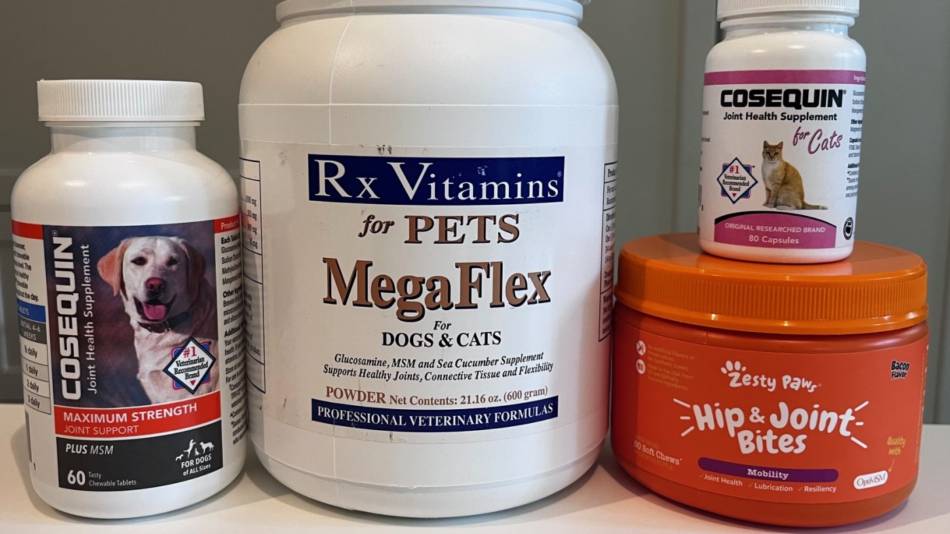
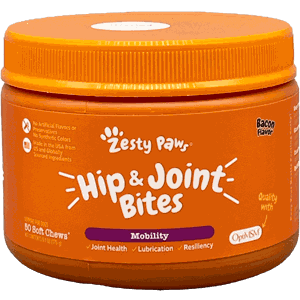
We tested products from Cosequin, RxVitamins, and ZestyPaws. One product was discovered to contain less than 10% of its listed chondroitin, and therefore, was Not Approved. (See What CL Found and How Products Were Evaluated.) 
Which is the best joint supplement for pets?
Products that passed CL's tests for having the labeled amounts of ingredients and not exceeding our strict limits on heavy metal contamination are noted as Approved in the Results table, where they are also compared. Approved products that provided high quality ingredients at a reasonable price — indicating superior value — were our Top Pick for Dogs and Top Pick for Cats.
What dose of glucosamine, chondroitin, and MSM is usually given to pets?
- Glucosamine and chondroitin: These may be used separately, but most supplements contain a combination. For a 25-lb. pet, a typical daily dose is 500 mg of glucosamine hydrochloride and 400 mg of chondroitin sulfate. Dosage for each of these ingredients should be adjusted depending on your pet's weight (see Dosage in ConsumerTips).
- MSM: An optimal dose has not been established.
Side effects of joint supplements for pets
Most of these ingredients can cause some gastrointestinal upset, such as nausea and diarrhea, and, although generally safe, some can interact with drugs, trigger allergies, or cause other side effects. MSM may have an aspirin-like effect and shouldn't be used by pets already taking blood-thinning medications, unless medically supervised (see Concerns and Cautions).
What other types of joint supplements are given to pets?
You may also want to read ConsumerLab's Reviews of supplements for pets that contain fish oil, turmeric, and CBD, all of which have been promoted for treating joint pain and inflammation in pets.
(Also see ConsumerLab's separate Review of Joint Health Supplements for People.)
Products tested in 2025
+— 18 sources
In addition the results of its expert testing, ConsumerLab uses only high-quality, evidence based, information sources. These sources include peer-reviewed studies and information from agencies such as the FDA and USDA, and the National Academy of Medicine. On evolving topics, studies from pre-print journals may be sourced. All of our content is reviewed by medical doctors and doctoral-level experts in pharmacology, toxicology, and chemistry. We continually update and medically review our information to keep our content trustworthy, accurate, and reliable. The following sources are referenced in this article:
- Butawan, Nutrients 2017
- Martel-Pelletier, Osteoarthr Cartil 2010
- Veronese, Ther Adv Musculoskelet Dis 2020
- Barbeau-Gregoire, Mol Sci 2022
- Barshick, Animals (Basel
- Belshaw, Prev Vet Med 2020
- Jerosch, Int J Rheumatol 2011
- Zhu, J Orthop Surg Res 2018
- Neil, J Am Vet Med Assoc 2005
- Paetau-Robinson, Vet Res Commun 2006
- Dakrory, Biomed Res Int 2015
- Jewell, J Anim Sci 2024
- Rondanelli, Nat Prod Commun 2021
- Taskozhina, J Clin Med 2024
- Bhathal, Open Vet J 2017
- McCoy, J Am Vet Med Assoc 2003
- Nobles, Can Vet J 2015
- Webster, J Vet Intern Med 2019
As a ConsumerLab.com member, you may print a copy of this report for your personal use.
You can access a special print version by clicking the "Print" icon in the upper right corner of this report.
You can then use your web browser's print functions to print the whole report or just selected pages.
You may also email or post a link to this report using the web address above.
Non-members using the link will see a free summary and can join to view the full report.
Other means of copying or distributing this report, in part or full, are not permitted.
If you are sight-impaired and your computer is having trouble converting the text in this report to speech,
contact us for assistance at [email protected] or by
phone at 914-722-9149.
The "Latest Update" date indicates when new clinical or product information was most recently added. In the full review (available to CL members), the newest information is highlighted in yellow and, if a new product is added, it is footnoted in the results table, showing the date added to the review. The year(s) when testing was completed for the products in the review appears at the end of the Summary section.
|