ConsumerLab.com uses JavaScript to provide the best possible experience for our content, but your browser has it disabled. Learn how to enable it here.
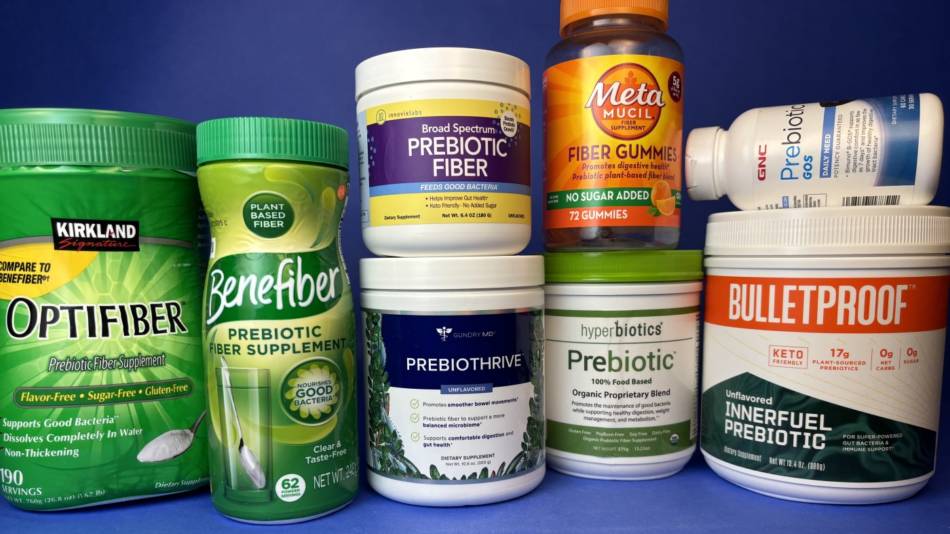
Prebiotic supplements provide soluble fiber that is fermentable and acts as food for microbes in the gut, which can turn it into other helpful compounds such as butyrate. There are a variety of sources of prebiotic fiber in supplements isolated from natural sources, such as chicory, acacia, larch, and guar, or synthesized to resemble natural prebiotic fiber. These prebiotic fibers include inulin (which contains fructooligosaccharides (also called FOS or fructans) and other prebiotic fibers), guar gum, and galactooligosaccharides (GOS) made from lactose from milk, and the semi-synthetic fibers: Partially hydrolyzed guar gum (PHGG), soluble corn fiber, and wheat dextrin. (See What It Is)
However, you can easily get prebiotic fiber from a wide variety of plant-based foods, including whole grains like oats and wheat, garlic, onions, and asparagus – which have the benefit of also providing forms of fiber that are nonsoluble and/or nonfermentable fiber and help with stool regularity.
Be aware that that not all soluble fiber is prebiotic fiber. The fiber found in psyllium is predominantly soluble but is nonfermentable and forms viscous gel which helps with laxation. Also, while the beta-glucans in oats and other grains are prebiotic, beta-glucans in mushrooms are less soluble and, likely, offer different benefits.
What are the health benefits of prebiotics?
Prebiotics may be beneficial in irritable bowel syndrome, constipation, blood sugar control, lowering cholesterol, and other conditions, although the evidence supporting some of these uses is mixed (see What It Does).
How much prebiotic should I take?
Clinical studies have used about 5 to 10 grams of prebiotic ingredient given once to three times per day, often starting with once daily to reduce initial gastrointestinal side effects (see What It Does).
What did ConsumerLab's tests of prebiotic supplements show?
Our tests showed that you often can't easily tell how much prebiotic fiber is actually in a prebiotic supplement. In fact, actual amount of prebiotic fiber in one product was only 26% of the listed amount of prebiotic ingredient. (See What CL Found and How Products Were Evaluated).
We also found the cost to get a gram of prebiotic fiber from supplements to range from just 5 cents to 85 cents.
What is ConsumerLab's Top Pick among prebiotics?
Our two Top Picks among prebiotics passed our tests showing that they contained all or more of the prebiotic fiber that we expected at a clinically relevant dose and relatively low cost (see Top Picks).
Are there side-effects with prebiotics?
Prebiotics can initially cause gastrointestinal discomfort, gas and bloating. This can be an issue for some people with irritable bowel syndrome and/or those following a low FODMAP diet that, by definition, restricts prebiotic fiber. People with liver disease should be cautious in using prebiotics. (See Concerns & Cautions)
Products tested in 2021, 2022 and 2024
+— 42 sources
In addition the results of its expert testing, ConsumerLab uses only high-quality, evidence based, information sources. These sources include peer-reviewed studies and information from agencies such as the FDA and USDA, and the National Academy of Medicine. On evolving topics, studies from pre-print journals may be sourced. All of our content is reviewed by medical doctors and doctoral-level experts in pharmacology, toxicology, and chemistry. We continually update and medically review our information to keep our content trustworthy, accurate, and reliable. The following sources are referenced in this article:
You must be a member to get the full test results along with ConsumerLab.com recommendations and quality ratings. You will get results for six prebiotic supplements selected for testing by ConsumerLab.com, as well as two others that are included for having passed testing in its voluntary Quality Certification Program.
In this comprehensive review, you'll discover:
Which prebiotic supplements failed our tests and which ones passed
CL's Top Picks among prebiotic supplements
Amounts of prebiotic fiber in each product -- something you can't easily tell from looking at labels
Price comparisons of prebiotic supplements
Information about natural sources of prebiotics in supplements such as chicory, acacia, larch, and guar, and prebiotic fibers including inulin (which contains fructooligosaccharides (FOS) and other prebiotic fibers), guar gum, and galactooligosaccharides (GOS) made from lactose from milk
What prebiotics can and cannot do for conditions such as irritable bowel syndrome and constipation, as well as blood sugar control, lowering cholesterol
How to get prebiotics from foods
Concerns, cautions, and potential side effects of prebiotics
Make sure you're choosing the best prebiotic supplements approved in our tests!
For a Limited Time, Become a Member for $1.25/week
Does taking a prebiotic supplement with dieting reduce weight or improve liver health among people with fatty liver disease? Find out what a recent study showed in the What It Does section of our Prebiotic Supplements Review.
Did taking a prebiotic supplement (Sunfiber) improve winter skin health in middle-aged people? Find out in the What It Does section of our Prebiotic Supplements Review, which includes our Top Picks among prebiotic supplements.
Did supplementing with inulin, a prebiotic, reduce the frequency, severity or duration of migraine in women? Find out what a recent study showed in our Prebiotics Supplements Review, which includes our Top Pick among prebiotics.
Find out who is most likely to suffer gastrointestinal discomfort when taking a prebiotic supplement, and what to do about it, in the Cautions and Concerns section of our Prebiotic Supplements Review, which includes our Top Picks among prebiotics.
Did supplementing with prebiotic fiber improve mood? Find out what a recent study showed in the Mood section of our Probiotic Supplements Review. Also see our Top Picks among prebiotic supplements.
Prebiotic For Immune Health?
June 23, 2023
Can taking a prebiotic reduce upper respiratory and gastrointestinal symptoms during colder months? Find out what a recent study showed in the What It Does section of our Prebiotic Supplements Review.
Did eating foods rich in prebiotic compounds improve mood in people with moderate psychological distress? See what a recent study showed in our Prebiotics Supplements Review.
Does supplementation with a prebiotic improve mood or sleep? See what a recent study found in the What It Does section of our Prebiotic Supplements Review, which includes our Top Picks among prebiotics.
As a ConsumerLab.com member, you may print a copy of this report for your personal use.
You can access a special print version by clicking the "Print" icon in the upper right corner of this report.
You can then use your web browser's print functions to print the whole report or just selected pages.
You may also email or post a link to this report using the web address above.
Non-members using the link will see a free summary and can join to view the full report.
Other means of copying or distributing this report, in part or full, are not permitted.
If you are sight-impaired and your computer is having trouble converting the text in this report to speech,
contact us for assistance at Membership@ConsumerLab.com or by
phone at 914-722-9149.
The "Latest Update" date indicates when new clinical or product information was most recently added. In the full review (available to CL members), the newest information is highlighted in yellow and, if a new product is added, it is footnoted in the results table, showing the date added to the review. The year(s) when testing was completed for the products in the review appears at the end of the Summary section.